← back to projects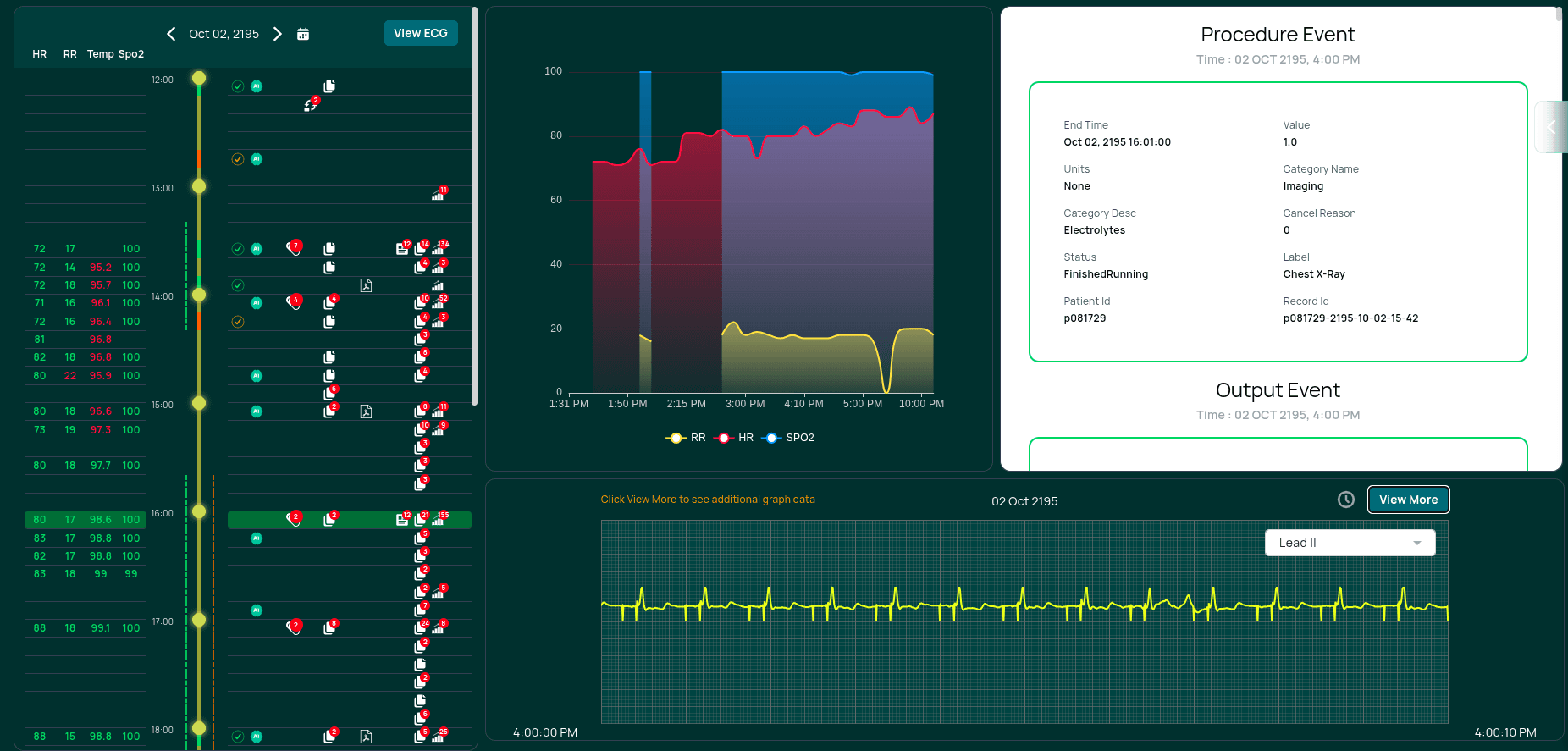
live2026
Clinical Data Analysis & Annotation Platform (MIMIC Data System)
A doctor-focused clinical analysis platform that visualizes multi-source patient data, enables event annotation, and generates structured outputs for AI training.
// tech stack
AngularRxJsTailwindCSSTypeScript
// about
Overview
This project is a clinical data analysis and annotation platform designed for doctors to analyze patient data from multiple medical sources and provide structured insights for AI training.
The system integrates high-volume clinical data such as ECG signals, vital metrics, and event logs, and presents them in an interactive, time-synchronized interface.
Problem Statement
Doctors require a unified system to:
- ▹View and analyze patient events over time
- ▹Correlate clinical events with vital signals
- ▹Interpret ECG and physiological data accurately
- ▹Provide structured annotations and reasoning for diagnosis
- ▹Generate high-quality labeled data for AI model training
Handling large, multi-source medical datasets while maintaining usability and performance is a major challenge.
Solution
I built a frontend platform that provides a synchronized and interactive view of patient data, enabling doctors to analyze and annotate clinical events efficiently.
Key Features
1. Timeline-Based Event Visualization
- ▹Implemented an interactive timeline showing all clinical events (admission, procedures, prescriptions, chart events)
- ▹Displayed event counts and categories for quick overview
- ▹Enabled precise navigation across different time blocks
2. Multi-Source Data Integration
- ▹Integrated multiple clinical data streams including:
- ▹ECG signals
- ▹Vital signs (HR, SPO2, RR)
- ▹Medical event logs
- ▹Ensured all data is time-synchronized for accurate analysis
3. Advanced Graph & ECG Visualization
- ▹Built dynamic charts for vitals and ECG signals
- ▹Enabled zooming, time-range selection, and detailed inspection
- ▹Displayed macro-level trends along with micro-level ECG segments
4. Contextual Data Exploration
- ▹Allowed doctors to view detailed notes and event metadata
- ▹Provided a structured view of procedures, prescriptions, and outputs
- ▹Enabled correlation between events and physiological changes
5. Annotation & AI Data Pipeline
- ▹Enabled doctors to assign criticality scores and provide reasoning
- ▹Structured outputs designed to feed AI models for training
- ▹Ensured consistency and accuracy in data labeling
Impact
- ▹Simplified complex clinical data analysis into a single unified interface
- ▹Improved doctor efficiency in reviewing patient history and events
- ▹Enabled creation of high-quality labeled datasets for AI training
- ▹Bridged the gap between raw medical data and AI-ready structured insights
Key Learnings
- ▹Handling multi-source medical data requires precise synchronization
- ▹UI clarity is critical when dealing with complex, high-density information
- ▹Performance optimization is essential for large datasets and interactive graphs
- ▹Designing for domain users (doctors) requires deep focus on usability and accuracy